When choosing the right commercial electrical estimating software, it’s important to understand the different types of tools available.
Possible solutions include:
Construction estimating & takeoff software: Tailored solutions for digital plan uploads, markup tools, quantity takeoffs, and material pricing databases to help speed up estimating for complex commercial projects.
Construction management software: Holistic software for general and/or specialty contractors to run their entire business from office operations to on-site project management. These platforms may offer built-in estimating and takeoff features or integrate with point solutions.
Field service management software: Comprehensive business software for contractors who primarily do service work. Features include scheduling and dispatching, field service mobile apps, estimating, service agreements, accounting integrations, and more.
Hybrid construction and field service software: Platforms that support both service and construction work in one system. These may have built-in estimating and takeoff features or integrate with point solutions.
The right solution for you depends on how your business is set up. If you exclusively do construction and install work, you may want digital takeoff software or construction management software. If you do a mix of construction/install and service work, you might consider a platform that offers estimating workflows for both of those divisions to consolidate your tool stack.
This article covers a few solutions across each category for you to explore, beginning with our own platform, ServiceTitan.
Commercial Electrical Estimating Software to Consider
Hybrid construction and field service software
Construction estimating and takeoff software
Construction management software
Field service management software
Hybrid Construction and Field Service Software
1. ServiceTitan
ServiceTitan is built for commercial specialty contractors who need a unified system across new construction, installation, service, and recurring revenue.
Here's how we support electrical contractors specifically with commercial estimating.
Create Opportunities Designed for Service or Project Work

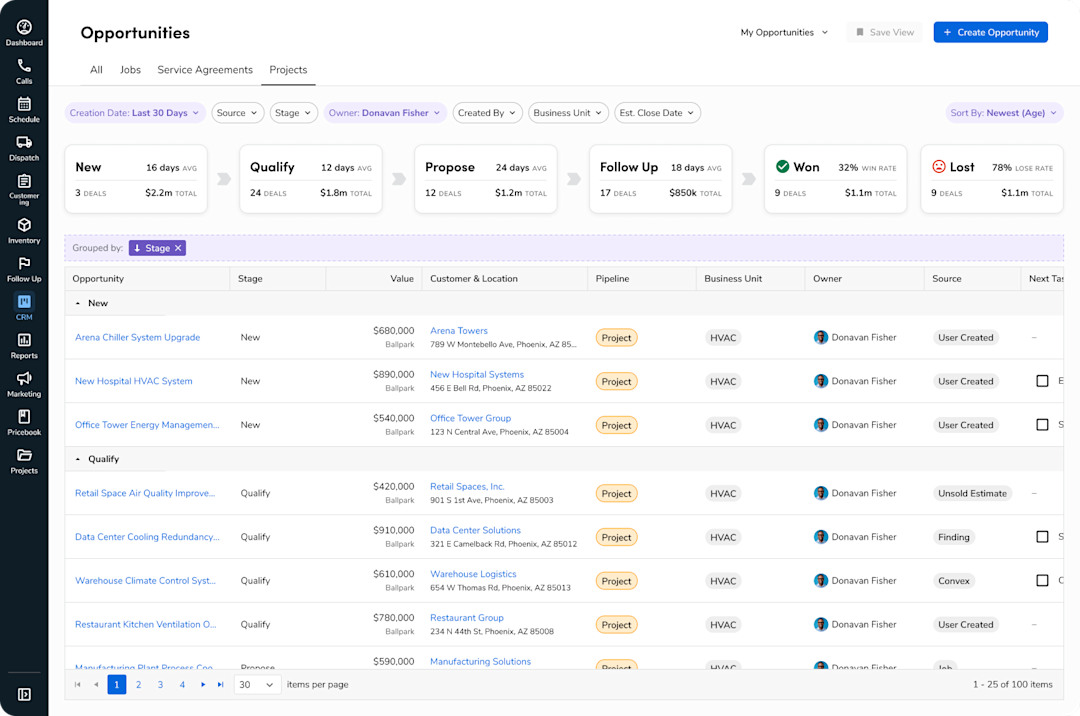
ServiceTitan CRM lets teams create service- or project-based opportunities with details like expected contract value, projected labor rates, and job location attached from the start. When the opportunity converts to a job, those details automatically flow into the workflows for managing the project, completing the job, or fulfilling the service agreement. Everything is managed in one system.
Electrical Estimating Workflows for Jobs, Projects, and Recurring Service
ServiceTitan gives contractors the flexibility to create different types of estimates:
For jobs where all the details of what’s needed are known (smaller projects or track home builds), office staff can build line-item estimates that specify exact services, equipment, and materials.
For larger, more complex projects where you need flexibility, you can use rough project estimates with summary totals to set budgets and track actual revenue and costs over time.
For recurring service contracts, you can create proposals defining the scope of work and terms for agreements.
Precise Line-Item Estimates for Jobs Where All Details Are Known Upfront

Contractors can build precise line-item estimates that list the exact services, materials, and equipment required for a job. Every item pulls directly from your pricebook, ensuring accuracy in material costs and consistency in pricing.
Line-item estimating is ideal for electrical installations where detailed scope and costs are known upfront. Estimates can also trigger purchase orders via requisitions, tying directly into purchasing and invoice closeout workflows for streamlined job costing and project management.
The #1 newsletter for the trades.
Rough Estimates for Complex Projects Where You Need Flexibility
Rough project estimates make it easy to build budgets for large-scale or long-term projects when every detail isn’t known upfront. Instead of listing specific equipment or materials, you can use summary tasks and revenue items to represent overall contract value and projected costs.
By setting up default project labels for pricebook items, job types, and technicians, budgets automatically populate in the Budget vs. Actual table, keeping expenses organized and easy to track. This method is especially useful for construction estimating and early-stage bids, where flexibility is key, and estimates need to be created quickly without every line item in place.
Note: ServiceTitan doesn't perform takeoffs directly, but it's built to receive your takeoff data, whether you import it from your preferred takeoff tool, upload from a spreadsheet, or enter it manually. Once your quantities are in ServiceTitan, they map automatically to your pricebook so costs are calculated accurately.
Proposals for Recurring Service Contracts and Maintenance Agreements

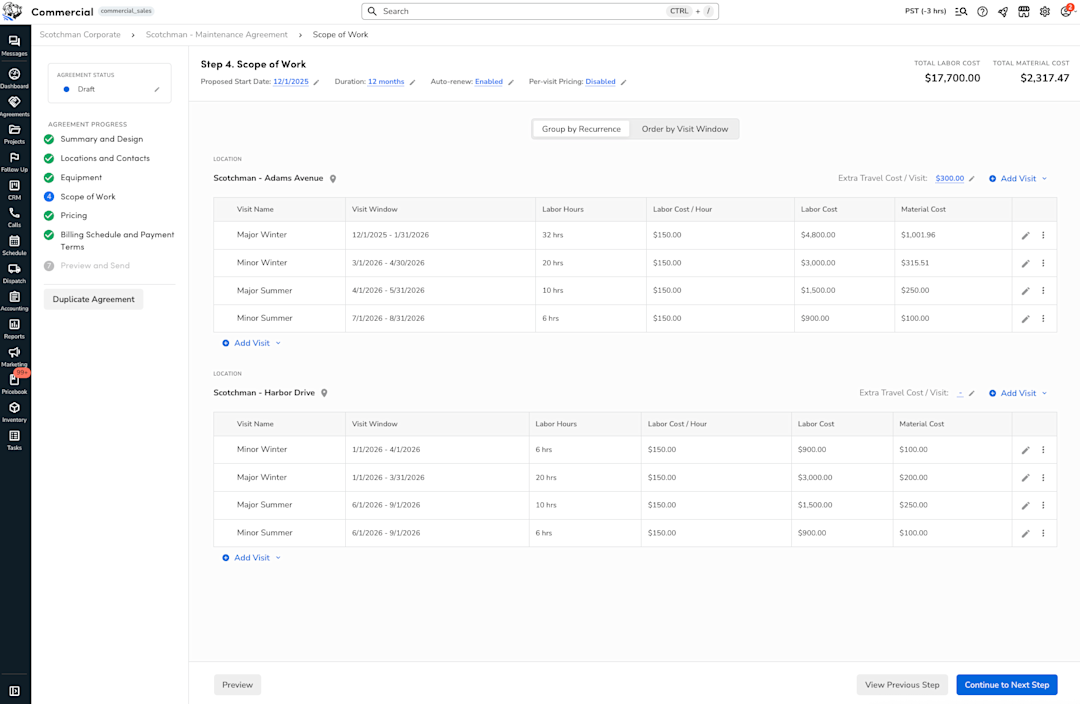
From within our commercial CRM, contractors can build out service agreement proposals including types of equipment to be periodically inspected or serviced, service schedules, material lists, payment schedule and terms, and more. Once the scope is defined, the system helps calculate profitable pricing based on your margin targets and enables you to send the agreement to your client for review and signing.
Manage Multiple Estimate Options from a Single Opportunity
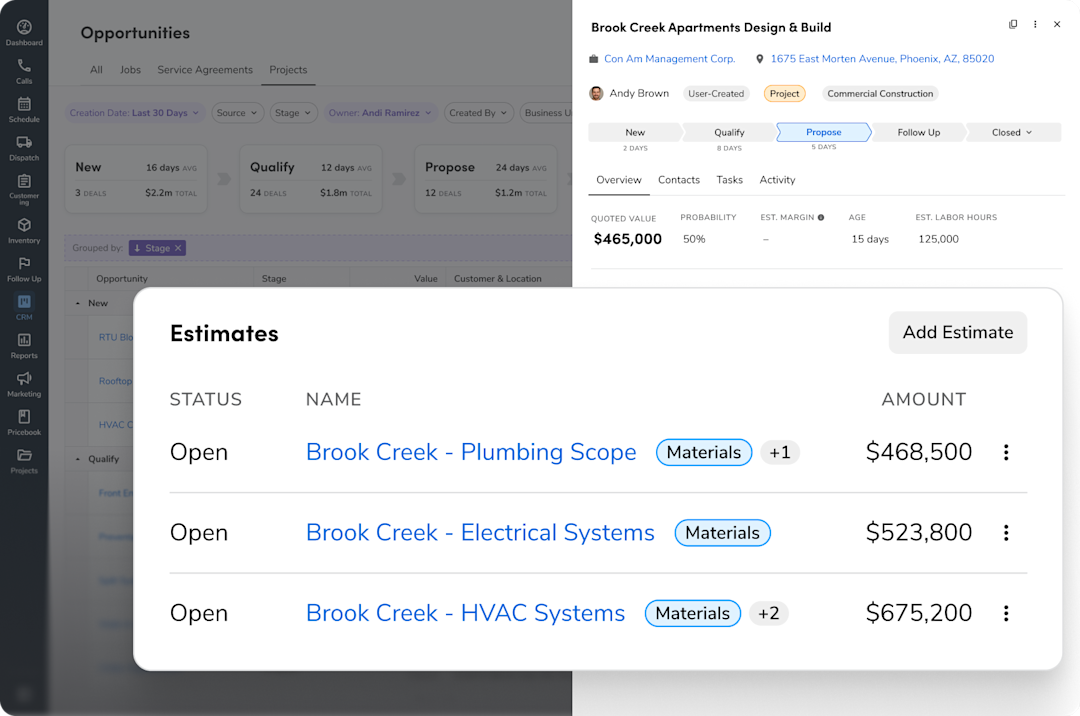
Contractors often submit multiple pricing scenarios to convey alternate scopes, value-engineered options, or phased approaches. With ServiceTitan, teams can create and manage multiple estimates under a single opportunity, keeping every version tied to the same job.
Estimated labor hours sync between estimates and the opportunity in real time, giving teams earlier visibility into staffing needs and helping leadership understand workload before contracts are signed.
Convert Won Opportunities Directly into Active Projects
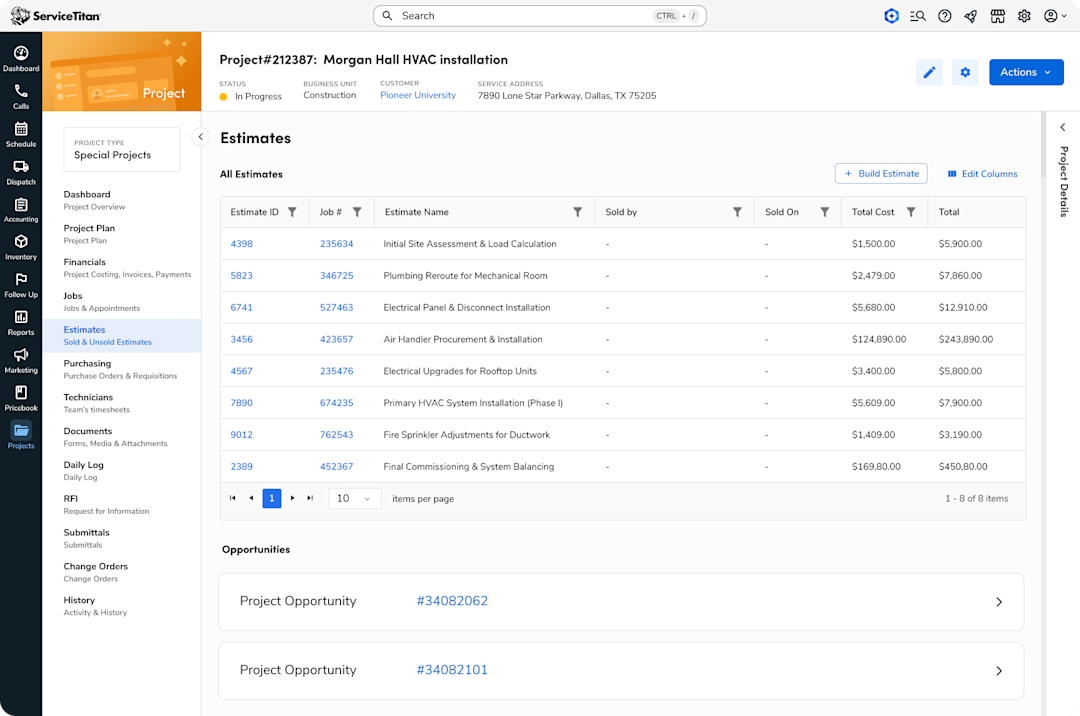
When a customer approves an estimate, users can mark it as sold either from the estimate itself or directly from the opportunity. Once sold, the opportunity automatically moves to Closed Won, and a project is instantly created.
The project inherits key information from the opportunity such as job details, dates, and estimates so teams can move into execution without re-creating records or re-entering data. Other estimate options can be dismissed or kept open, depending on how the job evolves.
Understand Why Opportunities Are Lost
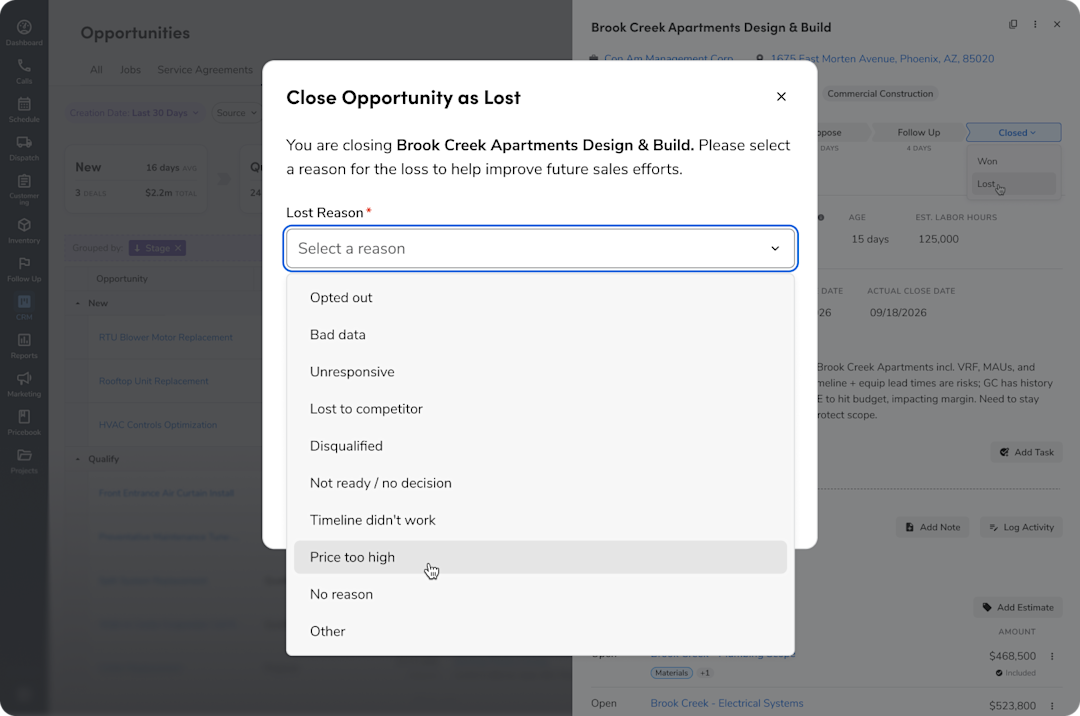
When an opportunity is marked as lost, users are prompted to select a Closed Lost Reason—such as pricing, scope changes, or competitor selection—and add comments for context. Automatically closed opportunities are flagged so teams can return later and update them with meaningful reasons.
Over time, this gives contractors clearer insight into why bids are lost, helping them refine pricing strategies, adjust scopes, and improve win rates across future projects.
Track Sales Team Performance with Out-of-the-Box Dashboards
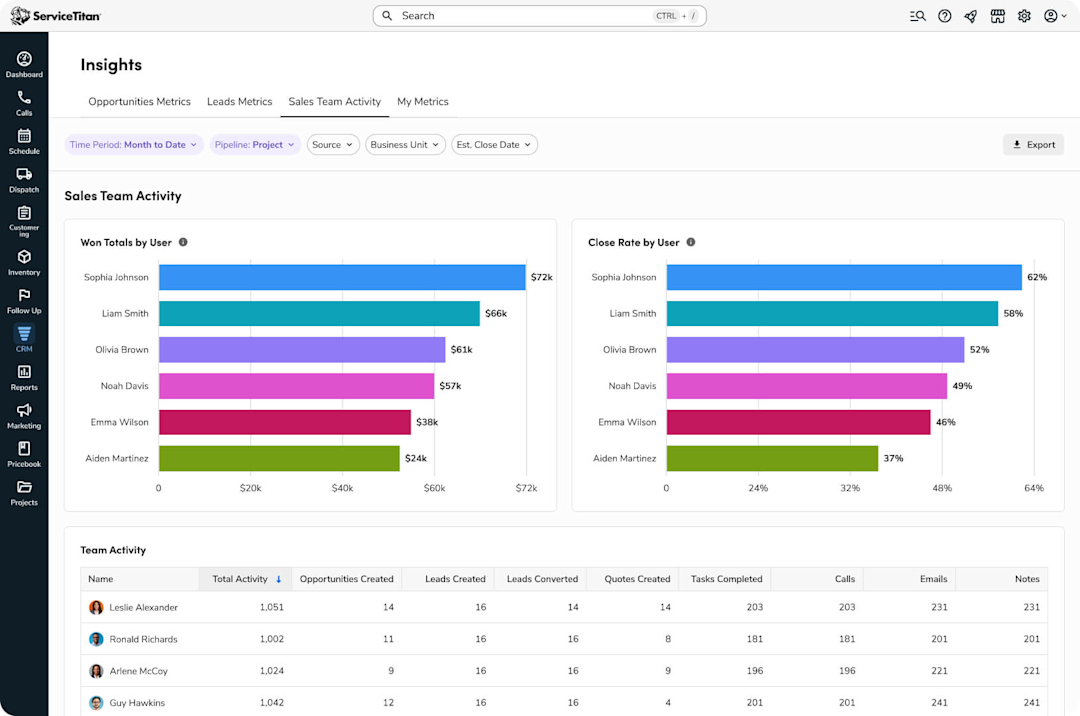
Our CRM offers built-in dashboards designed to support sales managers with:
Weekly or monthly team meetings
Win/loss tracking
Individual rep performance
Pipeline health monitoring
With minimal configuration required, it’s easy to open the dashboard and start managing.
Move Seamlessly Into Project Management and Collaboration

ServiceTitan also offers a robust suite of construction project management tools. Here’s a quick look at some key features in our project management workflow:
Project Dashboards: When a new residential or commercial project is created in ServiceTitan, a project overview page is automatically generated. From this dashboard, contractors and project managers can keep track of all project details in one place.
Project Planning: Keep projects on track with visibility into every phase. Create a dynamic plan that auto-updates progress and costs as work gets completed.
Daily Logs: Quickly generate standardized daily logs on site and instantly create detailed AI-powered summaries for GCs and stakeholders.
Crew Management: Complete projects on time with crew management tools to track schedules, capture time and progress in the field, and allocate resources for higher labor utilization.
Document Management: Centralize your drawings, plans, and documents in one secure place. With intuitive folders, filters, and search, let your project team quickly find and share what they need.
RFIs and Change Orders: Create and convert RFIs to change orders and track changes to completion in a single integrated platform with real-time financial and status tracking.
Progress Billing: Collect accurate payments on time with a clear view of your schedule of values. Generate AIA-standard payment applications in a single click.
Project Financials: Track progress and costs with a comprehensive financial view of every project and know what's been billed and what's still on the backlog. Access a detailed budget versus actual breakdown to get needed insights to make informed decisions and keep projects profitable.
Accounting Integrations: Ensure financial data is accurate across platforms with seamless syncing of accounting data with your preferred ERP.
Unify the Construction-to-Service Lifecycle

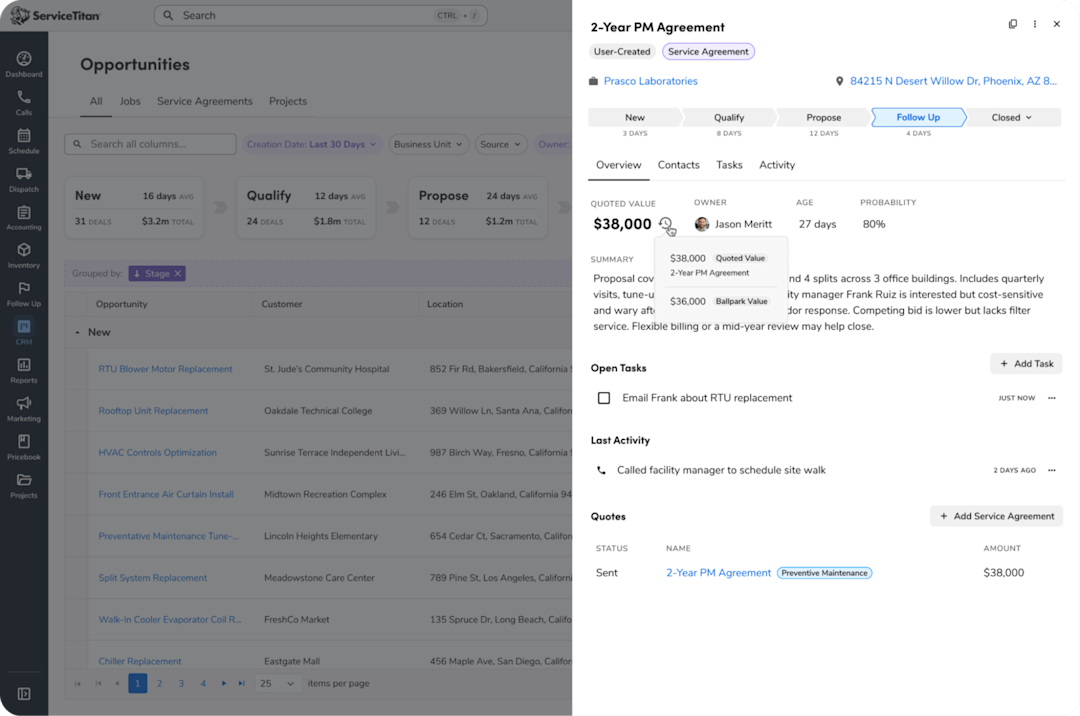
One of the more significant structural advantages ServiceTitan offers commercial service contractors is the connection between construction and service in a single platform. When a commercial installation project closes out, the installed equipment and service history don't need to be re-entered in a separate system. Warranty periods, service agreements, and preventive maintenance schedules can be built directly from project closeout, so your installed base automatically becomes your service base.
This matters because the recurring revenue that comes from long-term service agreements on installed equipment is often the most profitable part of a commercial contractor's business. Platforms that only handle the construction side of the job require a separate field service management solution, which creates data gaps, potential billing issues, and customer attrition when handoffs go wrong.
Get a Personalized Demo of ServiceTitan for Electrical Contractors
What we’ve covered above is just a sampling of the features that ServiceTitan offers for facilitating electrical estimating and project management. We also offer time tracking and timesheets, integrations with top accounting software such as QuickBooks, Viewpoint Vista, Sage Intacct, and more.
To see how ServiceTitan handles the full electrical contractor workflow, from pipeline to project closeout, schedule a demo for a one-on-one walk-through.
2. Simpro


Simpro is a field service and job management platform used by commercial trade contractors, with particular adoption among HVAC, electrical, plumbing, and fire protection businesses. It offers project management, estimating, scheduling, inventory management, and financial reporting, and is used in both service and project/construction contexts.
Simpro is one of the more capable commercial alternatives for contractors who need project-oriented workflows alongside service management. It has features for job costing, multi-stage project management, purchase orders, and inventory tracking that go beyond what lighter-weight service platforms offer.
Simpro has a stronger presence internationally (particularly Australia, New Zealand, and the UK) than it does in the U.S. market, which is worth factoring in for contractors who rely on local support resources, peer networks, or reference customers in their region.
3. BuildOps

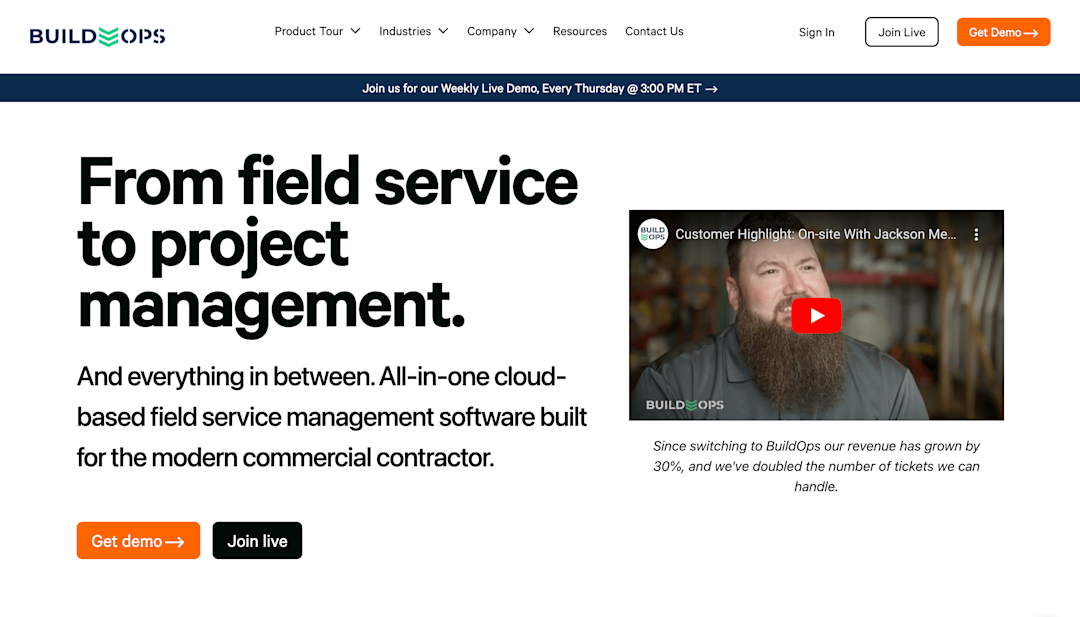
BuildOps is a platform built for commercial contractors that helps streamline operations, manage large-scale construction and maintenance projects, and collect payments from a single hub. It features tools for customer management, dispatching, project management, and a mobile application for field teams.
For more on BuildOps, check out our comparison article: ServiceTitan vs. BuildOps
Construction Estimating Software with Digital Electrical Takeoff
4. Trimble Accubid

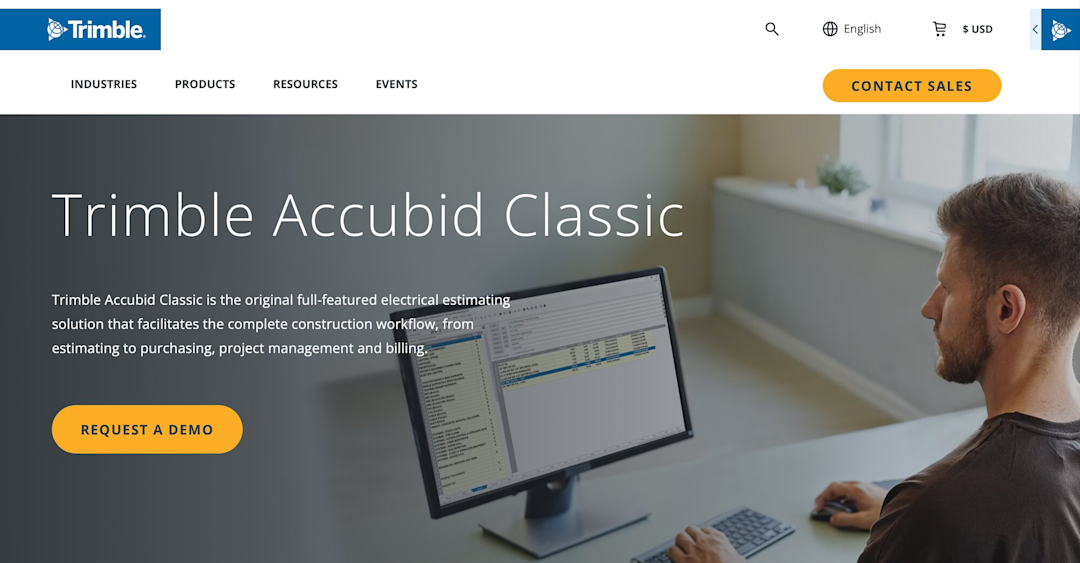
Trimble Accubid is a dedicated electrical estimating platform with a long track record in the industry. It comes in two versions: Accubid Classic, an on-premise solution with a material and labor database of over 40,000 items and 9,500 assemblies, and Accubid Anywhere, a cloud-hosted version that adds multi-user collaboration, change management, and submittal tracking. Both versions include graphical takeoff through Trimble’s LiveCount integration, multi-level phase breakdowns, and instant bid summaries.
Accubid is purpose-built for electrical and, in the case of Anywhere, industrial mechanical contractors — it doesn’t try to cover every trade the way broader construction platforms do, which makes it a strong fit for electrical shops that want deep estimating functionality without features they won’t use.
5. McCormick Systems


McCormick Systems’ core product integrates takeoff and estimating into a single workflow through Design Estimating Pro, a built-in digital takeoff tool that keeps quantities and pricing connected from measurement through bid creation. The electrical database includes over 55,000 items and 25,000 prebuilt assemblies, with pricing that can be updated directly from major pricing services or a contractor's preferred supply house.
Features like auto-count (for repetitive symbols on complex drawings) and a patented auto home run tool are built specifically around the realities of electrical plan takeoff.
McCormick comes in two tiers: the standard version for small and midsize shops, and McCormick Pro, which adds change order management, advanced executive dashboards, and more customizable job management screens. It covers commercial, industrial, residential, low-voltage, and solar work, so it's not limited to one segment of the electrical trade.
6. PlanSwift


PlanSwift, now part of ConstructConnect, is a takeoff and estimating tool used across a range of trades including electrical, HVAC, plumbing, concrete, drywall, and flooring. Its core strength is on-screen takeoff speed. Users can measure areas, lengths, counts, and perimeters directly from electronic plans using point-and-click tools, then drag pre-built assemblies onto takeoff items to calculate material, waste, and labor costs.
PlanSwift also offers trade-specific plugin packs (including one for electrical) and AI-assisted takeoff features through its Takeoff Boost toolset. It’s more of a takeoff-first tool than a full estimating platform, so electrical contractors looking for deep assembly databases or electrical-specific pricing workflows may find it lighter on that side. That said, it integrates with Excel and other estimating tools, making it a practical option for shops that want fast digital takeoff feeding into an existing spreadsheet-based estimating process.
Construction Management Software
7. Procore


Procore is a construction management software solution designed to serve a wide range of customers, including civil and infrastructure, general contractors, owners, public agencies, and specialty contractors. Procore offers comprehensive tools for preconstruction, project management, quality and safety, cost management, and more.
The platform also includes expansive integration capabilities with other software and provides extensive training resources and customer support, ensuring that users can maximize the software's potential.
8. Buildertrend

Buildertrend is a comprehensive construction project management solution built for home builders, remodelers, and specialty contractors. The platform offers a wide array of features including scheduling software and project planning, financial management, customer management, document management, and sales management.
With its customer relationship management (CRM) tools, construction professionals can track leads and manage customer interactions. In addition, its customer portal helps contractors streamline customer interactions by allowing clients to make selections, approvals, view project progress, and communicate directly with builders.
9. Fieldwire


Fieldwire is a construction management software designed to streamline communication and project coordination on the job site. Built for contractors, project managers, architects, and designers, Fieldwire's platform is designed to facilitate most aspects of onsite project management.
Key features include task management, punch list and inspection tools, blueprint viewing and versioning, scheduling and reports, and the ability to annotate and share plans and documents. Fieldwire also offers a mobile app, allowing users to access information, communicate, and view blueprints even when offline.
Field Service Management Software
10. ServiceMax

ServiceMax, like other field service solutions, is designed to provide better visibility into your field service operations. It offers a number of products, such as Asset 360 for Salesforce, ServiceMax core, ServiceMax FieldFX (their mobile app), and ServiceMax Engage (for customer engagement) to help manage your entire business.
For more on ServiceMax, check out our comparison article: ServiceMax vs. ServiceTitan
11. Service Fusion

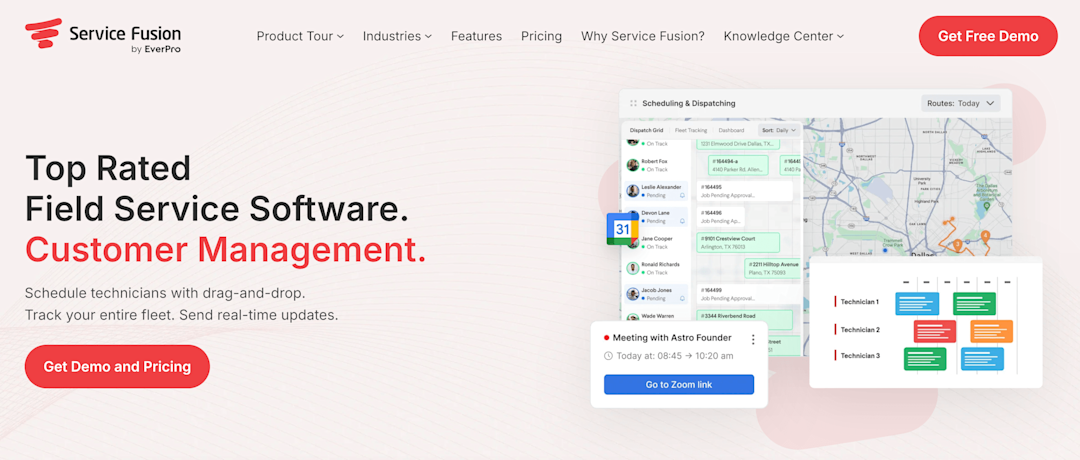
Service Fusion includes job scheduling, dispatching, GPS fleet tracking, estimates, invoicing, and customer communication tools. It supports multiple payment processors and offers mobile access for field techs. The platform is built for various trades and aims to centralize operations into one system without needing multiple software tools.
For more on Service Fusion, check out our comparison article: Service Fusion vs. ServiceTitan
12. ServiceTrade


ServiceTrade is a commercial-focused field service management platform serving HVAC, mechanical, plumbing, and fire and life safety contractors. Its core features include service agreement management, quoting, scheduling, dispatching, a mobile field app, and a customer-facing portal where commercial clients can view job history, approve quotes, and pay invoices.
ServiceTrade emphasizes commercial service operations and its customer portal experience, which allows facility managers and commercial property owners to interact with their service history online. It has a reasonable feature set for contractors whose primary workflow is recurring service and preventative maintenance under commercial contracts.
For more details, see our full comparison: ServiceTitan vs. ServiceTrade
What’s the Best Electrical Estimating Software for You?
The right electrical estimating software depends on how your business is set up and where the biggest gaps are in your current workflow.
If your estimating process is the bottleneck — slow takeoffs, outdated pricing, manual quantity counts — a dedicated takeoff and estimating tool like Accubid, McCormick, or PlanSwift can solve that specific problem. If you need broader project coordination across teams and trades, a construction management platform like Procore or Fieldwire may be the priority. And if service work is your primary revenue driver, a field service management platform covers scheduling, dispatching, and agreement management.
The tradeoff with any of those categories is that they cover one side of the business well and leave the rest to other tools. For electrical contractors running both construction and service work, that split usually means disconnected systems, duplicate data entry, and handoffs where details get lost (especially when a completed install should be turning into a service agreement).
That’s the gap ServiceTitan is built to close. Estimating, project management, service operations, and recurring revenue workflows all live in one platform, so your installed base becomes your service base without a manual handoff between systems.
To see how it works for commercial electrical contractors, schedule a demo for a one-on-one walkthrough.


ServiceTitan Electrical Software
ServiceTitan is a comprehensive electrical business software solution built specifically to help service companies streamline their operations, boost revenue, and achieve growth. Our award-winning, cloud-based platform is trusted by more than 100,000+ contractors across the country.